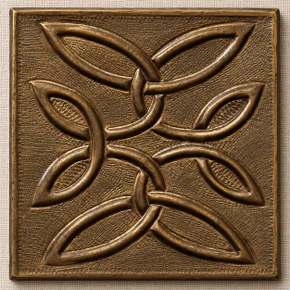


Four curling loops chase each other around a raised centre dot on these Celtic swirl knot tiles, a knot with no start and no end called the Rotating Loop Knot. The turning motion gives a grid of them a gentle movement, which suits living room walls as much as a kitchen.
Details
- Material: solid brass sheet about 1 mm thick, embossed by hand over a hand-punched ground
- Finish: aged bronze patina, sealed with wax
- Size: each tile is 10 x 10 cm (3.9 x 3.9 in)
- Depth: 6 mm, with a raised rim around each tile; the back is hollow and has a small hanger
- Comes as: sets of 30, 45 or 60 tiles, all in this one design
- Handmade: each piece is embossed to order, so relief and patina vary slightly from the photos
Sizes and coverage
Choose a quantity from the Set menu. Each tile covers 0.01 m² (0.11 sq ft), with tiles butted together.
- 30 tiles: 0.30 m² (3.2 sq ft), e.g. 6 x 5 tiles = 60 x 50 cm
- 45 tiles: 0.45 m² (4.8 sq ft), e.g. 9 x 5 tiles = 90 x 50 cm
- 60 tiles: 0.60 m² (6.5 sq ft), e.g. 10 x 6 tiles = 100 x 60 cm
The tiles cannot be cut, so plan the layout around whole tiles. A row of ten tiles runs 100 cm (39.4 in).
Where to use it
- A grid of tiles above a desk, sofa or console
- A few tiles hung singly from their hangers
- A band behind a range or along the sink wall
- A border around a fireplace surround or along the hearth
- Glued into cabinet doors, drawer fronts, trays or a tabletop
Installing and care
Set them like ordinary wall tile: butter the hollow back with tile adhesive, press each tile onto a flat, clean wall, then grout or caulk the joints once it has cured. A single tile can also hang on its own from the hanger on the back. Behind a cooktop, leave the clearance your cooktop maker asks for. Tiles cannot be cut, so work out the layout in whole tiles first. Clean with a soft, damp cloth and dry it off; scouring pads and harsh cleaners will wear through the patina.
This design sits in our brass wall tiles collection; Quaternary Celtic Knot Tiles and Celtic Loop Knot Tiles would work alongside it.