


Moroccan Lighting for Open Floor Plans: How to Define Each Zone
Posted by E Kenoz on 5th Apr 2026
Why Moroccan Lighting Works So Well in Open Floor Plans
Open floor plans are everywhere, and for good reason. They make homes feel bigger, brighter, and more social. But there is one challenge that almost every homeowner with an open layout eventually faces: how do you make one big room feel like it has distinct areas without putting up walls?
The answer is lighting. Specifically, Moroccan lighting. With its bold shapes, warm metallic finishes, and intricate cutout patterns, Moroccan lighting naturally draws the eye and anchors a space. When you hang a statement pendant over your dining table or mount a pair of sconces beside your sofa, you are telling everyone in the room exactly where one zone ends and another begins.
Let us walk through how to use different types of Moroccan fixtures to define every zone in your open floor plan.
Anchoring the Kitchen with Moroccan Pendant Lights
The kitchen island or breakfast bar is usually the first place people gravitate toward in an open layout. It is where meals get prepped, homework gets done, and conversations happen over coffee. A pair of Moroccan pendant lights hung at the right height instantly marks this as a dedicated workspace.
Brass pendants with geometric cutouts work especially well here. They cast patterned light across the countertop while keeping the overall look warm and inviting. Hang them 30 to 36 inches above the counter surface, and space them evenly so the light coverage feels balanced.
If your kitchen flows directly into a dining area, the shift in fixture style is what creates the visual boundary. The pendants say "this is the kitchen" without a single wall in sight.
Choosing the Right Size
For most kitchen islands, pendants between 10 and 16 inches in diameter hit the sweet spot. Go too small and they disappear into the ceiling. Go too large and they block sightlines across the room, which defeats the purpose of having an open layout in the first place.
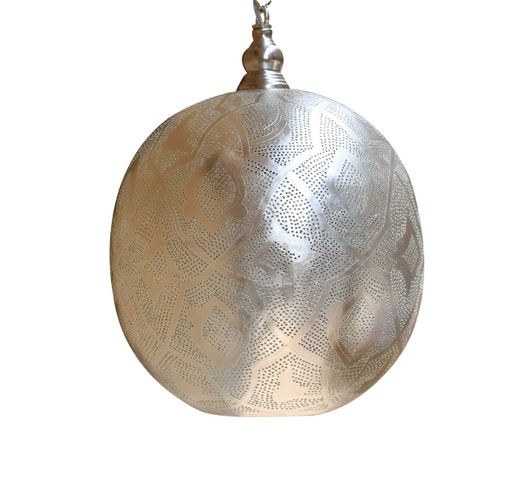
Defining the Dining Area with a Moroccan Chandelier
Nothing says "this is where we gather" like a single dramatic fixture centered over a dining table. A Moroccan chandelier does this beautifully. The ornate metalwork and warm glow create an intimate atmosphere even in a wide-open room.
The key here is scale. Your chandelier should be roughly one-half to two-thirds the width of your dining table. Hang it 30 to 34 inches above the table surface so it illuminates without obstructing eye contact across the table.
Coordinating Without Matching
You do not need your dining chandelier to be an exact match to your kitchen pendants. In fact, a slight contrast works better. If your kitchen pendants are simple pierced brass, try a dining chandelier with colored glass insets. The shared material (brass) ties them together while the different styles signal different zones.
Using Sconces to Frame the Living Area
The living room zone in an open floor plan often feels like the leftover space between kitchen and dining. Moroccan wall sconces fix that instantly. Mount a pair flanking your sofa or on either side of a media console, and the living area suddenly has its own identity.
Sconces are especially effective because they add light at eye level rather than from above. This creates a layered lighting effect that feels cozy and intentional. The shadow patterns from Moroccan sconces also add texture to walls, making flat drywall look a lot more interesting.
Creating a Reading Nook with a Moroccan Lantern
If you have a corner near a window or beside a bookshelf, a single Moroccan lantern on a side table or hung at low height can carve out a personal retreat within your open layout. This works especially well in homes where the open plan feels a little too exposed.
Choose a lantern with denser cutout patterns for a reading nook. The contained light creates a sense of enclosure that makes the corner feel sheltered and private, even without walls.
Layering It All Together
The magic of Moroccan lighting in open floor plans comes from layering multiple fixture types at different heights and intensities. Here is a simple framework:
- High and bright: Pendants over the kitchen island for task lighting
- Mid-height and dramatic: Chandelier over the dining table for ambient lighting
- Eye-level and warm: Sconces in the living area for accent lighting
- Low and intimate: Lanterns in corners for mood lighting
Each layer defines its zone while contributing to the overall warmth of the room. The brass finishes and handcrafted details tie everything together into a cohesive look.
Start With One Zone and Build Out
You do not have to light your entire open floor plan at once. Start with the zone that needs the most definition, usually the dining area, and add fixtures to other zones over time. Browse the full collection of Moroccan pendant lights and Moroccan chandeliers to find the right starting point for your space.